
Value leakage in a business sale is the gap between the theoretical price implied by an EBITDA multiple and the cash the seller actually receives at closing, caused by avoidable decisions during the sale process, not by an insufficient EBITDA.
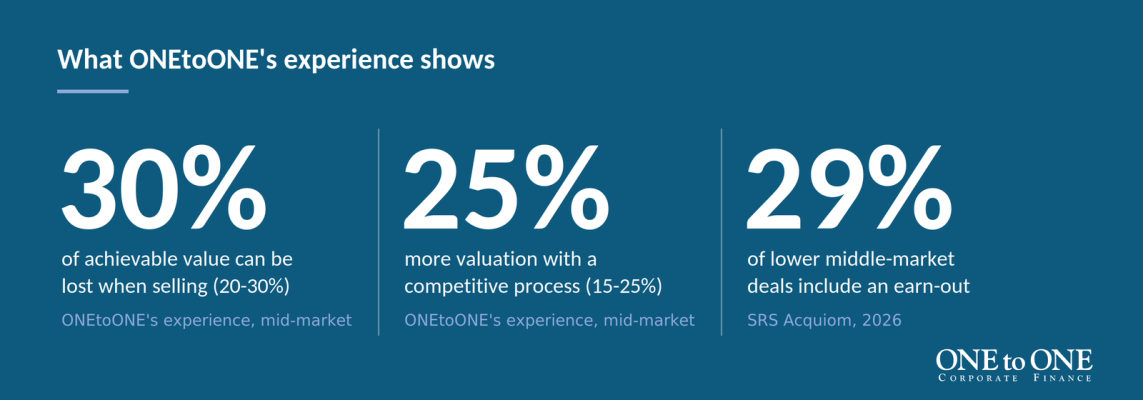
Most business owners assume the price they receive for their company is set by its EBITDA and a multiple. In reality, the headline number is only one of perhaps a dozen levers that decide how much cash actually reaches the seller’s bank account. Based on ONEtoONE Corporate Finance’s experience advising mid-market transactions, owners routinely give up 20-30% of the achievable value of their business — not because they negotiated badly, but because they did not know what was negotiable.
Value is lost at six specific points in the sale process, not just one: the buyer pool, the company narrative, technical working-capital and net-debt adjustments, earn-outs, tax structuring, and uninsured warranty exposure.
The gap between the asking price and the cash a seller ultimately receives is created in several places at once, not in a single negotiation. Each of these points can go unnoticed if it isn’t prepared in advance, because most of them are framed as «technical» deal mechanics rather than as value decisions.
Summary table: the 6 value leaks
Leak | What it means | How to mitigate it |
Buyer pool | A single buyer negotiates with no competitive pressure | Run a competitive process with qualified international buyers |
Company narrative | The same business, poorly told, compresses the multiple | Build a strong equity story before going to makret |
Working capital peg / net debt | «Technical» adjustments quietly transfer cash from seller to buyer | Model these mechanics months before opening the data room |
Earn-outs | Contingent consideration tied to metrics the buyer controls | Negotiate objective, seller-verifiable metrics |
Tax structuring | Tax impact not optimised before signing | Plan deal tax structuring in advance |
Warranty & Indemnity | Post-closing seller exposure left uncovered | Evaluate warranty & indemnity (W&I) insurance |
These six leaks rarely act alone — they usually combine, and their combined effect is what explains that 20-30% of lost value. This figure comes from ONEtoONE’s own experience advising mid-market transactions, not from a single variable.
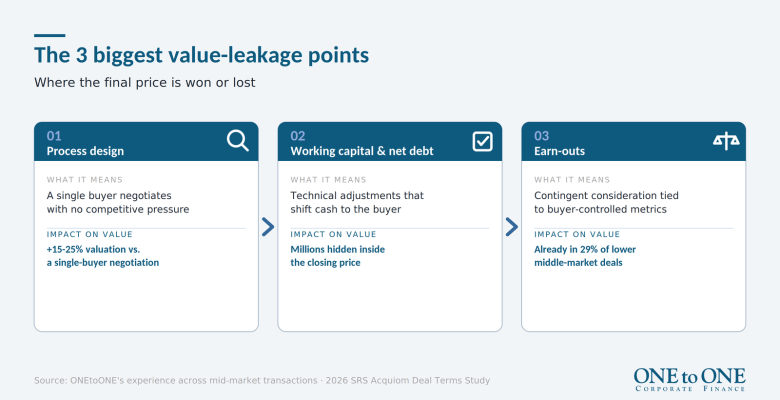
The three highest-impact leakage points are sell-side process design, working capital and net debt, and earn-outs with contingent consideration.
Based on ONEtoONE’s experience across its mid-market transactions, a well-managed, competitive sell-side process typically lifts valuation by 15-25% versus a single-buyer negotiation. The work to identify, qualify and engage the right international buyer universe is the single highest-return activity in any sale: the best buyer is rarely the closest one.
Working capital and net debt are usually framed as «technical» — and that is exactly the problem. A working capital peg set ten per cent too high transfers cash from seller to buyer at closing, often invisibly. Owners should model these mechanics months before a buyer ever sees the data room.
Earn-outs are on the rise: according to the 2026 SRS Acquiom Deal Terms Study, they now feature in 29% of lower middle-market deals (up to $50m) and 35% of the smallest deals (up to $25m), up from 19% in 2014. Sellers who accept loose, buyer-controlled metrics rarely collect what they were promised.
The leakage is preventable, but only with preperation. Three steps make the biggest difference.
1. Start the readiness work 12-18 months before any sale, not three.
2. Build a competitive international buyer universe – the best buyer is rarely the closest one.
3. Engage advisors who negotiate every clause in the deal, not only the multiple.
The price on the term sheet is not the price you receive. Owners who recognise this early — and who design a process around protecting the value they have already built — consistently outperform their peers by margins large enough to fund the next chapter of their lives.
Owners routinely give up 20-30% of the achievable value of their business, based on ONEtoONE’s experience advising mid-market transactions.
The cause is rarely poor negotiation – it´s not knowing which elements of the deal were negotiable: process, working capital, earn-outs, tax structuring and warranties.
A working capital peg is the reference level of working capital set in the purchase agreement; if actual working capital at closing falls below it, the price is adjusted downward.
A peg set just 10% too high can quietly transfer cash from seller to buyer, which is why it should be modelled months before the data room opens.
An earn-out is a portion of the sale price paid later, contingent on the business hitting specific targets after closing.
It’s risky because, per the 2026 SRS Acquiom Deal Terms Study, earn-outs already feature in 29% of lower middle-market deals, and sellers who accept buyer-controlled metrics rarely collect everything they were promised.
Based on ONEtoONE’s experience, a well-managed competitive sale process lifts valuation by 15-25% versus a bilateral negotiation with a single buyer.
The driver is competitive pressure: several qualified buyers competing for the asset improve both price and deal terms.
The recommendation is to start readiness work 12-18 months before a sale, not three.
That runway allows time to model working capital and net debt, build the company narrative, and assemble a competitive buyer universe before anyone sees the data room.
Whether you are planning to sell your business, acquire a company or explore strategic opportunities, ONEtoONE Corporate Finance provides expert support throughout the process. Our global network, industry expertise and technology-driven approach help clients achieve successful outcomes worldwide. Contact us to discuss your plans confidentially.