

I have always thought there is something quite similar between a merger or joint venture and a marriage. Two parties meet, discover that they have something valuable to offer each other, and begin to imagine what they could achieve together. They discuss their expectations, negotiate the terms of their commitment, and eventually agree to build a future together.
The courtship can be exciting. The wedding can be a success. But the real test begins afterwards, when both parties discover what it actually means to share a business.
Now imagine that the two parties come from different countries, operate under different legal systems, speak different languages, and have different approaches to decision-making, risk and authority. They may even have different ideas about what success should look like.
This is what makes cross-border mergers and acquisitions particularly challenging. The differences extend beyond corporate culture to the markets, regulations, customers and commercial environments in which the businesses operate.
This is the first in a three-part series exploring cross-border M&A, drawing on my experience in corporate finance and investment banking, including advising Japanese companies seeking to enter Saudi Arabia or expand their presence there. One lesson has stayed with me throughout my career: getting two companies to agree to a transaction is one challenge; getting them to work well together afterwards can be quite another.
Why do numerous cross-border partnerships fail after the deal closes?
I sometimes use the marriage analogy with a little humour, but there is a serious point behind it. In at least two partnerships I worked on earlier in my career, my team and I became involved again several years after the original transaction. Having initially helped bring the parties together, we found ourselves acting more like marriage counsellors and, ultimately, helping them navigate a separation.
I will not name the companies, but these experiences left a lasting impression on me. The original transactions had a sound strategic rationale, yet differences in expectations, management and control emerged over time. Market conditions changed, priorities shifted, and the relationship became increasingly difficult to manage.
Not every partnership can be saved, and not every joint venture should continue indefinitely. But clear governance, practical mechanisms for resolving disagreements and workable exit provisions can help the parties manage difficult circumstances without putting the entire business at risk. These are not pessimistic legal formalities; they are part of responsible planning.
Why is strategic fit not enough in cross-border M&A?
Cross-border transactions are often driven by complementary strengths. An international company may bring technology, engineering expertise or established products, while a local partner contributes market access, customer relationships, infrastructure and knowledge of the operating environment. Together, they may be able to build a business neither could develop as effectively alone. But the strategic logic is only the starting point.
During my investment banking career, I worked on assignments between Japanese industrial and technology businesses and Saudi companies and institutions. These covered sectors including commercial vehicle manufacturing, engineering, industrial automation, water treatment, power and advanced materials. Some assignments involved establishing joint ventures; others focused on acquisitions, restructuring existing partnerships or strengthening a company’s position in the Saudi market.
Across these different situations, a recurring lesson was the importance of understanding not only what each party could contribute, but also what each expected to gain.
Contributions versus expectations: a manufacturing example
Consider a manufacturing partnership. An international company may want to establish a local production platform, apply its technology and develop new customers. Its Saudi partner may see the opportunity as a way to build domestic industrial capabilities, develop local expertise and serve a growing market.
These objectives can complement each other, but they are not identical. The international company may prioritise protecting its technology and maintaining consistent quality standards. The local partner may place greater emphasis on technology transfer, local manufacturing and developing the business beyond its initial scope.
Both perspectives can be legitimate. The challenge is to establish a shared understanding of what the partnership is intended to achieve and how each party will contribute.
Will technology be transferred from the outset or introduced gradually? Who will be responsible for developing customers? How much investment will each party commit? What happens if demand grows more slowly than expected? Could either party eventually seek a different ownership structure?
These are not merely operational details. They go to the heart of the investment rationale. If the parties have different expectations, those differences need to be addressed before they become embedded in the business.
How do cultural differences affect cross-border M&A?
Cross-border transactions often bring together different communication styles, decision-making processes and attitudes towards risk. National culture can influence these differences, but it is only part of the picture.
A multinational corporation and a family-owned Saudi business, for example, may have very different management cultures. One may rely on formal approval processes involving its headquarters abroad. The other may place greater emphasis on direct relationships and decisions taken by the owners. Neither approach is inherently better. The challenge is making them work together.
If these differences are misunderstood, they can gradually undermine trust, particularly when neither side makes an effort to understand the other’s working practices.
In my experience, advisors must look beyond the formal transaction and help both parties understand how the other organisation actually operates. This requires listening carefully, asking the right questions and distinguishing genuine differences in commercial objectives from differences in communication or decision-making.
What should due diligence cover in a cross-border deal?
Another important consideration is whether the business model can work in the target market. A product may need to be adapted to local customer requirements. A distribution model may depend on relationships that take years to develop. A manufacturing investment may require a different approach to suppliers, workforce development or customer qualification. Regulation and the broader operating environment can also influence the pace and structure of market entry, particularly in industrial and infrastructure-related sectors.
For this reason, due diligence should extend beyond historical financial performance. Buyers and investors need to understand key commercial relationships, regulatory dependencies, competitive positioning and realistic prospects for growth. The objective is not to eliminate every uncertainty; that is rarely possible. It is to identify the uncertainties that matter most and decide how they will be managed.
This is particularly important for mid-market companies. An overseas acquisition or joint venture can represent a significant commitment of capital and management time. Unexpected integration costs or slower-than-anticipated growth can have a material impact on the investment.
Which questions should you ask before signing a cross-border deal?
The most productive cross-border discussions are not necessarily those in which everyone agrees easily. They are those in which both parties are prepared to challenge assumptions before those assumptions become commitments.
I believe business owners and investors should address three questions early in the process.
First, what does each party really want to achieve? The answer should go beyond financial returns to include market position, technology, operational capabilities and the intended future direction of the business.
Second, what will each party contribute? Contributions may include capital, assets, intellectual property, management expertise, customer relationships or access to distribution channels. These should be clearly understood rather than left to general expectations.
Third, what happens if circumstances change? Market conditions, investment requirements and strategic priorities can evolve. The parties should consider how they will respond if the original business plan no longer reflects reality.
These conversations are most valuable before negotiations become dominated by valuation, ownership percentages and legal wording.
When should you compromise in a cross-border negotiation?
Successful cross-border M&A also requires a balance between flexibility and discipline. An advisor who insists on winning every negotiating point may damage a relationship before it has a chance to develop. Equally, compromising on an issue fundamental to the investment rationale can undermine the transaction itself.
Some differences can be resolved through clearer procedures, phased commitments or performance-based arrangements. Others, such as essential protections over intellectual property or meaningful decision-making rights, may go to the heart of the deal. The challenge is to distinguish between what can be negotiated and what must be protected.
Ultimately, the objective is not to secure a short-term negotiating victory. It is to create a business that can deliver sustainable value over time.
What does a cross-border M&A advisor do beyond closing the deal?
A cross-border M&A advisor does more than identify a buyer, seller or potential partner. The advisor should help test the commercial logic, challenge assumptions and ensure that both parties have a realistic understanding of what the transaction requires.
This may involve helping an international investor understand the local market, helping a local company assess the value of a foreign partner, or identifying potential conflicts between the parties’ expectations before they become difficult to resolve.
Rather than focusing exclusively on completing the transaction, an experienced advisor can also help ensure that the proposed structure supports the business strategy.
Of course, no advisor can guarantee that two businesses will work well together. That responsibility ultimately rests with the parties themselves. But the right advice can help them make better-informed decisions before committing substantial resources.
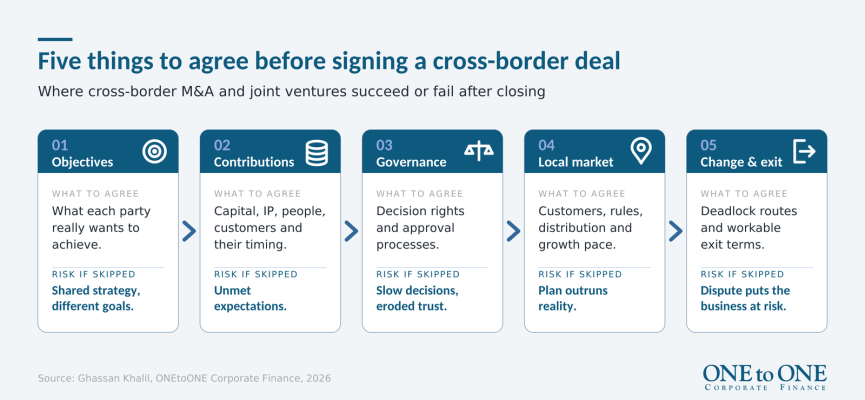
Cross-border M&A at a glance: what to agree before signing
| Area | What can go wrong | What to agree early |
| Objectives | Different expectations, e.g. protecting technology versus technology transfer | What each party really wants to achieve |
| Contributions | Capital, IP, customers or management left to general expectations | What each party will contribute, and when |
| Governance and culture | HQ approvals and owner-led decisions clash; trust erodes | Who decides what, and how |
| Local market | Product, distribution and regulation take longer than planned | Due diligence beyond historical financials |
| Change and exit | Demand grows slowly or priorities shift | Dispute-resolution mechanisms and workable exit provisions |
Strategic fit is only the beginning
Cross-border M&A can create opportunities through new markets, stronger capabilities, technology transfer and partnerships that deliver value to both sides. But a compelling strategic rationale is only the starting point.
The parties must understand each other’s expectations, appreciate the realities of the local market and establish a practical basis for working together. Time spent addressing these issues before signing can help prevent misunderstandings, improve decision-making and create a stronger foundation for long-term success.
For business owners and investors considering an international acquisition or joint venture, the key question is not simply whether the deal makes sense on paper. It is whether the parties can turn that strategic logic into a business that works in reality.
Frequently asked questions about multiples valuation
What is cross-border M&A?
Cross-border M&A is a merger, acquisition or joint venture between companies based in different countries.
The parties operate under different legal systems, languages and approaches to decision-making, risk and authority, which makes these deals more complex than domestic ones.
Why do cross-border joint ventures fail?
Most fail not because the strategic rationale was wrong, but because differences in expectations, management and control emerge over time.
Clear governance, practical mechanisms for resolving disagreements and workable exit provisions help the parties manage these situations without putting the business at risk.
What questions should you ask before a cross-border deal?
Three: what each party really wants to achieve, what each will contribute and what happens if circumstances change.
These conversations are most valuable before negotiations become dominated by valuation, ownership percentages and legal wording.
What should due diligence cover in a cross-border acquisition?
It should go beyond historical financial performance to test whether the business model can work in the target market.
That means understanding key commercial relationships, regulatory dependencies, competitive positioning and realistic prospects for growth.
What does a cross-border M&A advisor do?
Beyond identifying a buyer, seller or partner, the advisor tests the commercial logic, challenges assumptions and makes sure both parties understand what the transaction requires.
More than 70% of the transactions ONEtoONE Corporate Finance advises on are cross-border.

Author | Ghassan Khalil
ONEtoONE Corporate Finance M&A Advisor
Ghassan Khalil is an M&A advisor at ONEtoONE Corporate Finance in Saudi Arabia.
He is an investment banker with more than 25 years of experience in corporate finance, M&A, capital markets and private equity, including joint ventures, restructuring, ECM, DCM and IPO execution.
Having advised top-tier clients across the MENA region, including Japanese companies seeking to enter or expand in Saudi Arabia, he specialises in cross-border M&A, joint ventures and capital markets transactions across the MENA region.
About ONEtoONE Corporate Finance
ONEtoONE Corporate Finance is an M&A Advisory Network specialising in mergers and acquisitions for mid-market companies. With a presence in more than 50 countries, we support business owners and executives through the most important corporate decisions of their careers.