

M&A is back, but buyers have become more selective. Deal value has jumped in 2026, yet fewer deals are being done, and most of the growth comes from a handful of very large transactions. For owners of mid-sized companies, that changes what it takes to sell well.
What is happening in the M&A market in 2026?
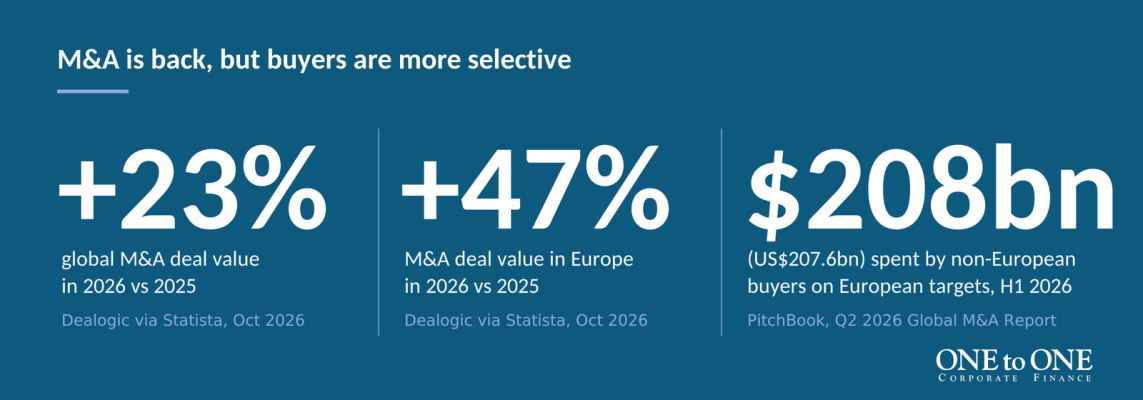
Global M&A deal value is up 23% on last year, and up 47% in Europe, according to Dealogic data compiled by Statista (October 2026).
The number of deals tells a different story. LSEG counted just over 28,000 announced deals worldwide between January and July, 10% fewer than a year earlier. More money is going into fewer, bigger transactions.
Why does the mid-market feel quieter?
Because the headline growth comes from a few mega-deals, not from more mid-sized ones. Mid-market buyers are still active, but they are paying less: PitchBook puts the median European EV/EBITDA multiple at 8.9x so far this year, down from 9.8x in 2025.
What are selective buyers looking for?
Buyers still have money to spend, but they put it into companies that hold up under scrutiny. More owners are also heading to market: in a CMS and Acuris survey of European M&A experts, a recovery in valuations was the reason most often given for sellers coming forward. To stand out, a company needs:
- Reliable numbers: audited accounts, a clean normalised EBITDA and a clear view of net debt.
- A credible plan: one that buyers can check against past results.
- A strong team: management that doesn’t depend on the founder.
- No surprises: legal, tax and contract issues sorted before due diligence starts.
Weak preparation rarely kills a deal, but it costs money through price cuts and tougher terms. We explain how in Selling your business: the 6 mistakes that cost owners 20-30% of value.
Why is the right buyer often abroad?
Because foreign buyers see good value in Europe, and a company in your sector can pay for synergies that others can’t.
According to PitchBook, buyers from outside Europe spent US$207.6 billion on European companies in the first half of 2026, across 819 deals. Lower entry prices than in North America and a large pool of family-owned businesses are a big part of the appeal. In the third quarter, US investors were involved in a record 45.7% of European private equity deal value.
A competitor, or a company in a neighbouring sector, can often outbid everyone else because the deal helps it cut costs, cross-sell and enter a new market faster. Selling across borders has its own challenges, which we cover in our cross-border M&A series.
How should you prepare to sell in 2027?
Start 12 to 18 months ahead and focus on five things.
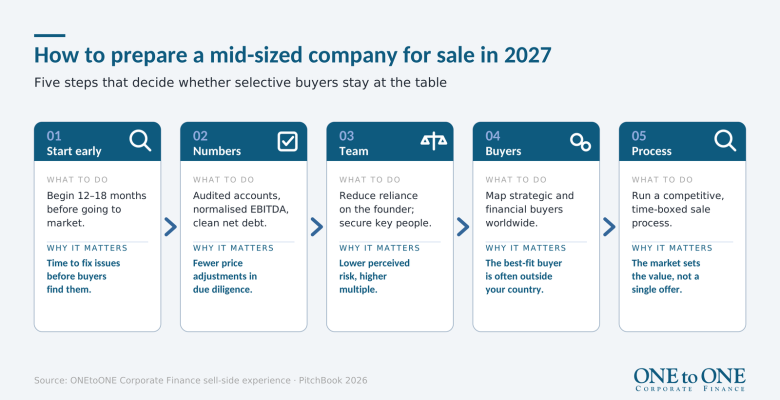
- Start early, so you can fix issues on your own timetable.
- Get the numbers buyer-ready, and consider a vendor due diligence.
- Strengthen the team and keep key people on board.
- Look for buyers worldwide, not just the ones you already know.
- Run a competitive process, so the market sets the price.
Conclusion
In 2026, the companies that sell well are the ones that are ready for scrutiny and in front of the right buyers, wherever they are. With a presence in more than 50 countries, ONEtoONE’s sell-side advisory team finds the buyers a local search might miss and brings them to the same table. That way, your company is valued by the market, not by a single offer.
Frequently asked questions
Is 2026 a good year to sell a business?
By value, yes: deal value is up 23% globally and 47% in Europe (Dealogic via Statista), but buyers are pickier, so preparation matters more than timing.
A well-prepared company with several interested buyers can achieve a strong price even when the market slows.
Why are foreign buyers acquiring European companies?
Mainly because European companies cost less than comparable North American ones, and there are many family-owned businesses to choose from.
PitchBook recorded US$207.6 billion of European acquisitions by non-European buyers in the first half of 2026.
How long does it take to sell a mid-sized business?
The sale process itself usually takes six to twelve months, after 12 to 18 months of preparation.
Due diligence findings and regulatory approvals, especially in cross-border deals, can stretch the timeline.
Does a foreign buyer pay more?
Often, when it gains synergies that local buyers can’t, such as entry into a new market.
The best price usually comes when foreign and local buyers compete in the same process.
About ONEtoONE
Whether you are planning to sell your business, acquire a company or explore strategic opportunities, ONEtoONE Corporate Finance provides expert support throughout the process. Our global network, industry expertise and technology-driven approach help clients achieve successful outcomes worldwide. Thinking about selling in 2027? Contact us to discuss your plans confidentially. Contact us