

AI in due diligence means using artificial intelligence to review contracts, detect financial anomalies and assess risk far faster than manual review — while the target’s own AI has itself become a key object of that review. Due diligence has long been the most labour-intensive phase of any M&A transaction. In 2026 it is also the phase where AI has produced the most measurable change.
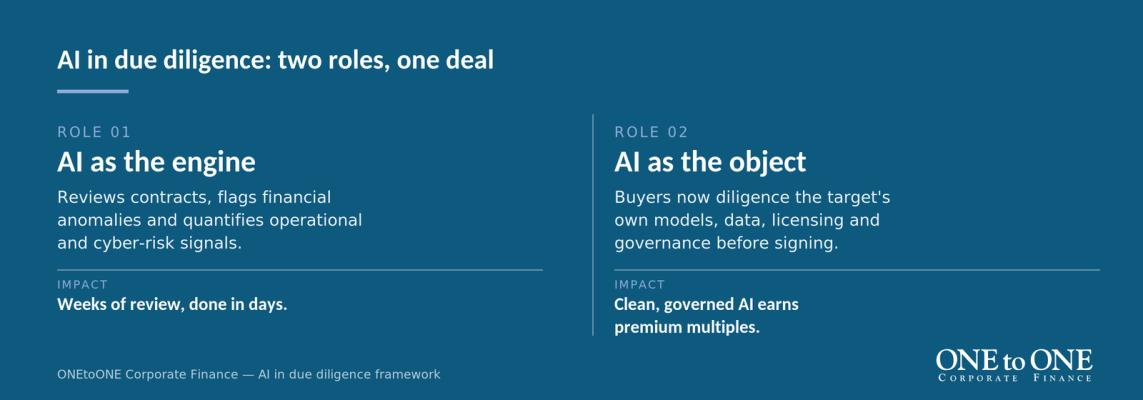
AI is doing two things at once: making diligence faster and sharper, and becoming a central object of that diligence. The backdrop is rapid adoption — according to Deloitte’s 2025 GenAI in M&A Survey, around 86% of dealmaking organisations now use generative AI, and McKinsey estimates it can cut deal costs by roughly 20%.
How is AI used as the due diligence engine?
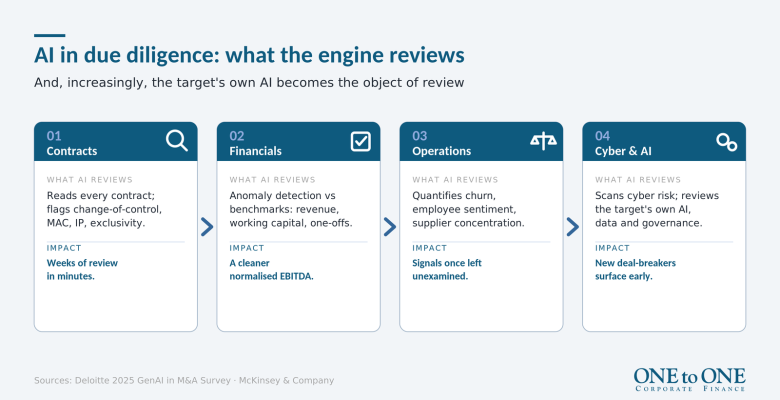
As an engine, AI reads every document in a data room with consistent scrutiny, flags risky clauses and surfaces financial anomalies in minutes rather than weeks. What used to take associates several weeks now happens in days, and the shift is qualitative as well as quantitative: advisors are freed from line-by-line review to focus on judgement, structuring and negotiation strategy.
Across a typical data room, AI now reviews:
- Contracts — change-of-control clauses, MAC provisions, IP assignments and exclusivity restrictions, flagged in minutes.
- Financials — anomaly detection against industry benchmarks to surface revenue-recognition issues, working-capital distortions and one-off items unlikely to survive a normalised EBITDA.
- Operations — customer churn, employee sentiment and supplier concentration, now quantified from data that previously went unexamined.
- Cybersecurity — vulnerability scans are now standard.
Why has AI itself become an object of due diligence?
Because AI is now a value driver inside target companies, buyers must diligence the AI itself — and this new layer is repricing or killing deals. Acquirers are walking away when they uncover:
- Unclear IP ownership over models or training data.
- Unlicensed training content — use of third-party content to train proprietary models without proper licensing.
- Infringing outputs — model outputs that may infringe third-party rights.
- Weak governance — weak or undocumented model governance.
- Data-privacy exposure — under GDPR, the EU AI Act and cross-border transfer rules.
For sellers, this changes what “clean” looks like. The way a company builds, trains and deploys AI is now part of its enterprise value. Businesses with documented data lineage, clear licensing and proper governance are commanding premium multiples; those without are seeing offers cut or, in some cases, withdrawn entirely.
What does AI-driven due diligence mean for sellers and buyers?
For owners, the implication is simple: prepare your AI before a banker is mandated. Treat AI hygiene with the same rigour as the financial audit — because waiting until diligence begins is now too late, and the cost shows up in the price.
A practical seller checklist:
- Document your models — architecture, purpose and dependencies on third-party providers.
- Map your data sources — establish clear data lineage: where data came from and how it was processed.
- Secure your licences — confirm rights to all training content and third-party models.
- Document governance — controls for bias, security, oversight and regulatory compliance.
For buyers, the new diligence requires a combination of legal, technical and financial skills that few teams have in-house. The competitive edge in M&A is no longer access to information; it is the discipline of using AI well and the experience to know what it cannot see.
Frequently asked questions
How is AI used in due diligence?
AI in due diligence is the use of artificial intelligence to review contracts, detect financial anomalies and assess operational and cyber risk in days rather than weeks.
AI platforms read every document in a data room with consistent scrutiny, flag risky clauses, compare financials against benchmarks and quantify operational signals. This frees advisors to focus on judgement, structuring and negotiation rather than line-by-line review.
What is AI due diligence in an M&A deal?
It is the review of a target’s own AI — its models, training data, licensing, governance and data-privacy exposure — because AI is now a value driver that can make or break a deal.
Buyers increasingly diligence the AI itself, not just with AI. Unclear model or data ownership, unlicensed training content, weak governance or GDPR / EU AI Act exposure can reduce valuations or stop a transaction.
What AI risks can kill or reprice an M&A deal?
Unclear IP ownership of models or training data, unlicensed third-party training content, infringing outputs, weak model governance, and data-privacy exposure under GDPR and the EU AI Act.
These are the issues acquirers walk away from. For sellers, clean data lineage, clear licensing and documented governance increasingly command premium multiples; their absence leads to cut or withdrawn offers.
How should sellers prepare their AI before a sale?
Document your models, data sources, licences and governance before a banker is mandated, and treat AI hygiene with the same rigour as a financial audit.
Waiting until diligence begins is too late — the cost then shows up directly in the price. Preparing AI early protects enterprise value and avoids surprises that can derail the process.
Does AI replace advisors in M&A due diligence?
No. AI accelerates document review and analysis, but successful deals still depend on human judgement, structuring and negotiation.
The edge in M&A is no longer access to information; it is the discipline of using AI well and the experience to know what it cannot see — the legal, technical and financial reading AI does not deliver on its own.
About ONEtoONE
Every transaction is unique. At ONEtoONE Corporate Finance, we provide business owners with expert guidance on sales, acquisitions and strategic growth opportunities. Speak with our team confidentially to explore your next move.