

Multiples valuation is the M&A method that estimates a company’s price by applying a market multiple (on sales or EBITDA) drawn from comparable transactions or deals.
A company’s value and its price are not the same thing, and confusing the two is the costliest mistake in any M&A deal. Antonio Machado put it succinctly a century ago: “Only the fool confuses value and price.” Warren Buffett translated it into investor language: “Price is what you pay; value is what you get.”
Value is the outcome of applying a valuation method: how much a business is intrinsically worth, regardless of who buys it.
Price, by contrast, is the outcome of a negotiation between buyer and seller, shaped by expectations, market context and synergies. Understanding this distinction is the essential starting point before discussing multiples valuation — the most widely used, and most widely misunderstood, tool in M&A.
Is multiples valuation a genuine valuation method?
Academia recognises only two valuation approaches: the cost approach (liquidation value — what the business would be worth if its assets were sold and its debts paid off) and the income approach (discounted cash flow, or DCF), which measures a business’s future cash-generating capacity.
The comparables approach — also known as the multiples method, and referred to in everyday M&A usage as multiples valuation — is not part of that academic canon. It emerged from professional practice and is now indispensable in M&A for two reasons: it serves as a cross-check for DCF, confirming whether the value obtained through discounted cash flow falls within a reasonable price range, and it serves as a direct price reference, because buyers and sellers always ask what multiple similar deals have closed at. Multiples are a compass, not a GPS: they don’t calculate a business’s intrinsic value, they place the negotiator within a reasonable market price range. In M&A, the final price can diverge from the calculated value — negotiation does the rest.
Enterprise Value, Equity Value and the Equity Bridge: anatomy of the calculation
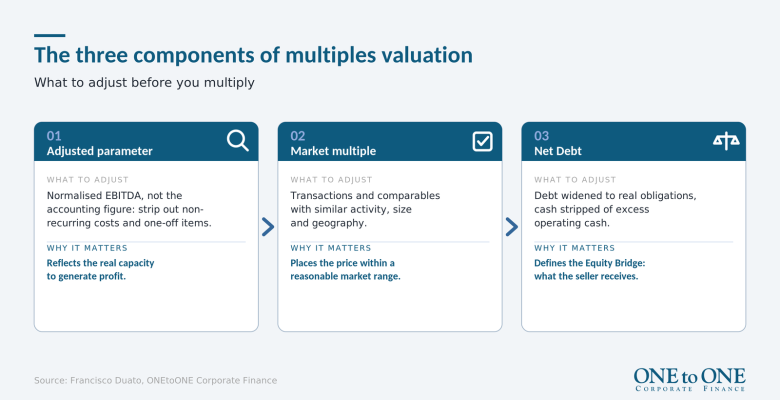
The method is built on three components that need to be understood separately before multiplying anything:
Component | Formula | What it measures |
Enterprise Value (EV) | Parameter × Multiple | The total value of the business, free of debt and cash |
Net Debt | Debt − Cash (adjusted) | The bridge between the value of the business and the value to shareholders |
Equity Value | EV − Net Debt | What the seller actually receives |
The Equity Bridge — the set of adjustments that take you from Enterprise Value to Equity Value — is one of the most critical and sensitive points in any company sale process.
The adjusted parameter: why the accounting EBITDA figure is (almost) never the right one
The parameter is the figure — sales, EBITDA or EBIT — that is multiplied by the market multiple. The most common mistake when applying multiples valuation in M&A deals is taking the parameter straight from the accounts without analysing it: financial statements reflect a company’s historical reality, but that reality can be distorted. The purpose of the EBITDA adjustment is to show the parameter as the buyer would actually receive it under normal operating conditions. There are four types of adjustment that a rigorous adviser always reviews:
- Non-recurring items: severance payments, restructuring costs, extraordinary advisory fees or gains from asset sales that won’t recur.
- Non-operating items: income and expenses linked to non-operating assets, such as vehicles or property for private use.
- Off-market transactions: related-party transactions or payments to partners and directors that don’t reflect market conditions.
- Inadequate accounting entries: capex booked as an operating expense, maintenance costs recorded as R&D, or capital grants recognised in full within the financial year.
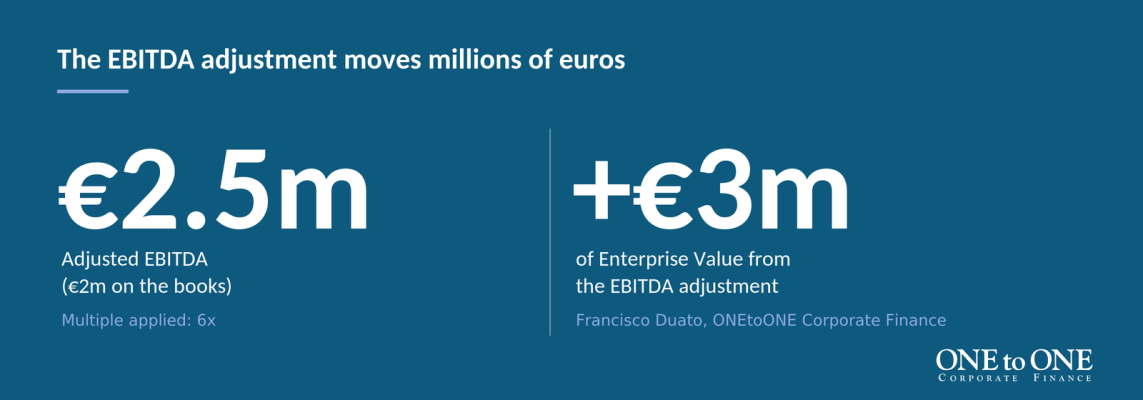
The impact of these adjustments is substantial: EBITDA moving from €2 million on the books to €2.5 million adjusted, applied to a 6x multiple, increases Enterprise Value by €3 million. Adjustments matter — a great deal.
The market multiple: where it comes from and what its extremes mean
The multiple is drawn from three sources: corporate transactions involving comparable companies (databases such as Capital IQ, Mergermarket or Orbis), academic databases (the sector multiples Aswath Damodaran publishes annually) and comparable listed companies. Comparability is judged against five simultaneous criteria:
- Activity and business model: position in the value chain, cost structure, product portfolio.
- Size: turnover and headcount.
- Geography: the markets the business operates in.
- Profitability: EBITDA margin and sales per employee.
- Type of organisation: multinational, single-site, holding company.
Extreme multiples are always a signal: very high ones usually capture strategic value or synergies the buyer expects; very low ones reflect special situations, such as a divestment of a non-core unit, a business in difficulty, or a transaction between related parties. Neither extreme is representative of the market and both should be excluded from comparables analysis.
Net Debt and the Equity Bridge: where deals fall apart
Net Debt (debt minus cash) looks like a simple calculation, but it’s one of the biggest sources of controversy in any M&A negotiation.
The adjustment has a dual purpose. On the debt side, the concept needs to be widened beyond bank liabilities to include any obligation with a genuine economic effect on the buyer: liabilities with an explicit cost owed to fixed-asset suppliers, debts to group companies that don’t arise from trading, and overdue spontaneous liabilities.
On the cash side, excess cash needs to be stripped out to leave only the operating cash actually required, incorporating the working capital adjustment (NWC). The date on which these adjustments are calculated is also negotiated, through two closing mechanisms with very different implications:
Mechanism | How it works | Advantage | Risk |
Locked Box | Fixed date, usually the last audited accounts | Figures are known at signing | Post-closing changes aren’t captured |
Completion Accounts | Date as close as possible to actual completion | Reflects the business’s true position | Final figures aren’t known until the end |
Many sale agreements fall apart not because of the agreed multiple, but over how Net Debt is interpreted. Defining precisely what counts as “debt” and what counts as “cash” — before signing, not after — avoids surprises running into hundreds of thousands of euros.
The mistakes that destroy the most value in the mid-market
Getting multiples valuation wrong in the mid-market of Spain and Latin America, where ONEtoONE Corporate Finance operates through local teams in more than 50 countries, costs business owners real money. The same failures repeat, deal after deal:
- Wrong parameter chosen: using sales when margins aren’t comparable, or EBITDA when a fixed-cost structure distorts small revenue variations.
- Missing definitions in the Letter of Intent (LOI): failing to set out in writing what counts as debt, cash or adjusted EBITDA — terms with no universal definition — and signing without negotiating them can cost hundreds of thousands of euros.
- Unnormalised EBITDA: taking the parameter straight from the accounts without stripping out non-recurring costs or non-operating items.
- Poorly selected comparables: choosing companies that aren’t comparable by activity, size or geography.
- Unfiltered transactions: including deals that reflect the sale of non-core units or one-off synergies.
- Ignored structural differences: overlooking that owned versus leased assets, outsourced processes or geographic diversification justify different multiples even for the same activity.
Methodology makes the difference
Multiples valuation is, at once, the most widely used and the most widely misunderstood method in M&A. Three seemingly simple variables — parameter, multiple and debt — conceal dozens of methodological decisions capable of moving the outcome by millions of euros. Between a rigorous valuation and a superficial one, the difference isn’t one of nuance — it’s a difference in the final price.
As Francisco Duato, M&A advisor at ONEtoONE Corporate Finance, with more than two decades advising on company sale-and-purchase deals, points out, the quality of advice at the valuation stage is what separates a well-founded negotiation from an improvised figure — including how each term is defined from the letter of intent onwards.
If you’re considering selling your company, acquiring a target business, or simply want to understand what lies behind the multiple you’ve been offered, ONEtoONE Corporate Finance’s global team — with a presence in more than 50 countries — can help you build a valuation with the rigour the deal demands. Contact our team for a confidential consultation.
Frequently asked questions about multiples valuation
What’s the difference between Enterprise Value and Equity Value?
Enterprise Value is the total value of the business regardless of how it’s financed, calculated by multiplying a parameter (sales or EBITDA) by the market multiple.
Equity Value is what the seller actually receives if the deal is structured as a share purchase, obtained by deducting Net Debt from Enterprise Value. The difference between the two — the Equity Bridge — can amount to several million euros depending on how the debt and cash adjustments are defined.
Why do you need to adjust EBITDA before applying the multiple?
Because financial statements reflect a company’s historical reality, not necessarily its normalised capacity to generate profit.
Unadjusted EBITDA can include non-recurring costs, non-operating items, off-market transactions or inadequate accounting entries. Adjusting it correctly can move Enterprise Value by millions of euros: taking EBITDA from €2 million to €2.5 million with a 6x multiple adds €3 million in value.
What is Net Debt and how does it affect a company’s final price?
Net Debt is the difference between a company’s financial debt and its cash at a given date, adjusted to include every obligation with a genuine economic effect and to strip out excess cash.
It’s the element of the Equity Bridge that generates the most controversy in M&A negotiations, because its exact definition — what counts as debt and what counts as cash — directly determines how much the seller is paid.
What’s the difference between a locked box and completion accounts?
They are the two closing mechanisms used to fix the date on which debt and cash are calculated in an M&A deal. A locked box sets an earlier date, usually the last audited balance sheet, with the advantage that both parties know the figures at signing, though there’s a risk that later changes go uncaptured.
Completion accounts calculate debt and cash as close as possible to actual completion, better reflecting the company’s true position, though the final figures aren’t known until the end of the process.
Why is multiples valuation not considered an academically recognised valuation method?
Because academia only recognises the cost approach (liquidation value) and the income approach (discounted cash flow, or DCF) as valuation methods proper.
The comparables approach emerged from M&A professional practice, not financial theory, and its legitimacy comes from its real usefulness as a DCF cross-check and a price reference in transactions, not from formal theoretical grounding.

By Francisco Duato.
ONEtoONE Corporate Finance M&A Advisor
Francisco Duato is an M&A advisor at ONEtoONE Corporate Finance in Valencia.
He holds a PhD in Economics, Business Administration and Management from the Catholic University of Valencia, a degree in Business Studies from the University of Valencia, and a PDD and Executive Education Certificate from IESE Business School (University of Navarra).
With extensive experience in M&A transactions, he is one of the leading professionals in company valuation and M&A processes in the Spanish and international markets.
About ONEtoONE Corporate Finance
ONEtoONE Corporate Finance Group is an M&A Advisory Network specialising in mergers and acquisitions for mid-market companies. With a presence in more than 50 countries, we support business owners and executives through the most important corporate decisions of their careers.