Part VIII: Cloud Restaurants

Author picture

Share  

The digitalization of many industries, combined with the COVID situation, has shaken up and transformed the restaurant industry as it adapts to survive. Restaurants, regardless of the segment they appealed, had the same model for decades, if not centuries. You sit down, order, eat and pay (what differentiated from one to the other was this order). As a result, came the on-demand delivery companies. The Deliveroo, Glovo and Uber eats of live provided restaurants, which had a finite sit in capacity to extend their orders to an online audience. This new revenue stream developed in the idea of creating restaurants, or branded kitchens that only sold through on-demand delivery platforms.

Part IV: Omnichannel Marketing for E-Commerce

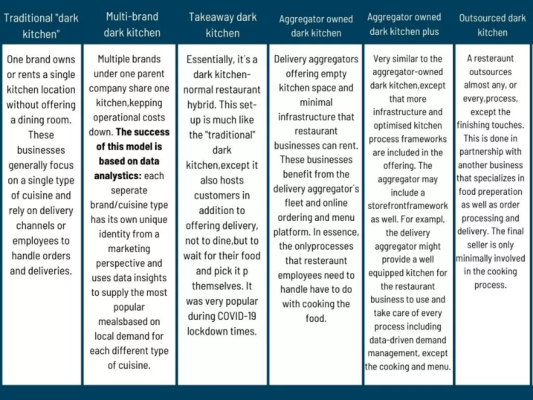
Cloud restaurants are known by various names such as ghost kitchens, shadow kitchens, virtual, or dark kitchens. However, the basic idea remains the same: restaurants have an online presence, customers order their food through food aggregator apps or through the restaurant’s own app, but the restaurants themselves don’t have dine-in facilities. Similarly, many retail food chains such as McDonalds, KFC, etc they have expanded this revenue stream, and have also streamlined their digital sales operations to a Dark Kitchen model. Moreover, companies like Rebel Foods (formerly Fassos) base their sole business model on digital sales. This has given way to an exponential propagation of companies that develop many brands representing different cuisines under the same company. They fall under different strategic models. Some operate under the same roof, others operate based on the demand and delivery facilities optimization.
Business model explained

Advantages over traditional restaurants:

  • Low Operational Cost
  • Low Set up and Introduction Cost
  • Allow to better segment the target audience
  • industry 4.0 – Automation, traceability and Data


Tabla Cloud Restaurants

Applied Metrics 

  • Food cost % of total costs
  • Food cost % per item

= Item Cost / Selling Price

  • Menu Item Profitability

= (Total Number of Items Sold x Menu Price) – (Total Number of Items Sold Per Item Portion Cost)

  • Preparation

= (prep) Times per item

  • Quality Rating
  • Rejection Rates (of orders)


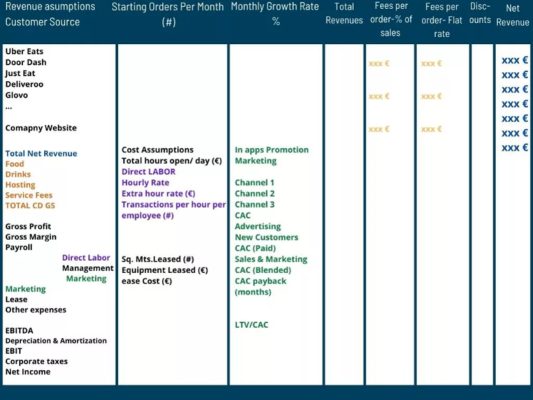
P&L Assumptions

P&L Assumptions

José Ramírez Terc, specialist in 21st century business models, wrote this article.

About ONEtoONE

Our company, ONEtoONE Corporate Finance, is specialized in international middle-market M&A advisory. We are continuously focusing on improving the techniques to achieve the best possible price for our clients, and we also advise on acquisitions, strategic planning and valuation. We are pleased to give our opinion about company valuation or other aspects of a possible corporate operation. If you need an advisor while buying or selling a company,
contact us.

Table of contents