

The surge of interest in Big data has soared to record highs in recent years. Moreover, it has become of increasing importance to businesses globally. However, many business owners are left confused over what it actually is and how it can truly help their company.
Big Data analytics aids companies in harnessing their data and using it to identify new opportunities. Furthermore, this leads to more carefully thought-out business moves, more efficient operations, higher profits, and happier customers.
How can you define it?
It refers to vast, complex sets that are both structured and unstructured. These sets are generated at an extremely high-speed rate and transmitted from a multitude of different sources such as transaction processing systems, customer databases, documents, emails, medical records, internet clickstream logs, mobile apps, and social networks.
Given that these sets are so large, traditional processing technologies can’t handle them. However, these vast amounts of can be leveraged to solve business challenges that you previously couldn’t solve. For example, the ability to estimate metrics, including consumer loyalty has been facilitated significantly with the introduction of Big Data. It allows for higher prediction power.
You may be interested in José Ramírez Terc´s Understanding 21st Century Business Model. In this series, he explores the ways in which modern business models born with the internet boom are changing how companies operate.
What are Big Data´s attributes?
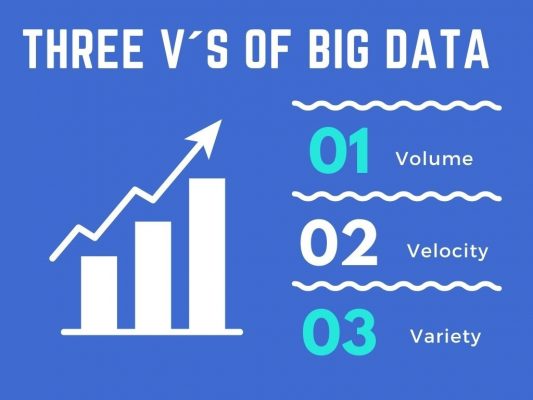
1. Volume in Big Data
It is the enormous amount of information being stored. When we are dealing with Big Data, we have to process extremely high volumes of unstructured and low-density data. For example, we are attending to Twitter data feeds, clickstreams on a web page or a mobile app, or sensor-enabled equipment.
2. Velocity in Big Data
When looking at the velocity we are talking about the incredible speed at which data streams must be processed and analysed. Companies and organizations must be able to harness it and develop real-time insights from it; otherwise, it is worthless. Real-time processing enables decision-makers to move fast, providing them with a competitive advantage.
3. Variety in Big Data
Variety refers to the many types of data that are available. The majority of large data is unstructured, which means it does not fit seamlessly into a typical model. A huge data stream might include anything from emails and movies to scientific and meteorological data, each with its own set of characteristics.
You might be interested in Big data and its impact on M&A.