

Artificial intelligence is entering every stage of a transaction, from finding targets to due diligence and valuation. For many entrepreneurs, this raises legitimate concerns. Will an algorithm decide what a company is worth? Will years of work be reduced to a data output? The reality is far more reassuring.
AI is already part of the process
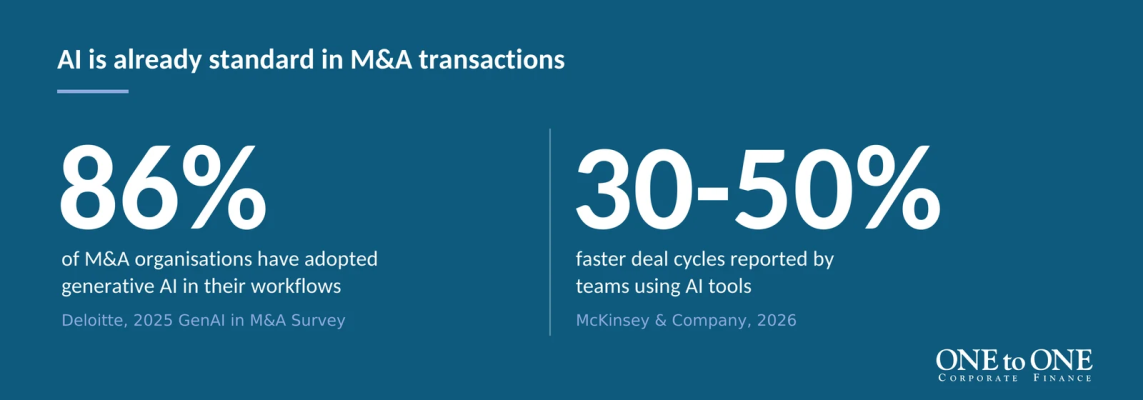
AI is no longer an experiment in dealmaking. A Deloitte survey of 1,000 senior corporate and private equity investors in the US found that 86% have adopted generative AI in their M&A workflows, mostly in the early phases of a deal. Investors use it to screen companies, analyze large volumes of documents and benchmark valuations.
What AI does well
AI excels at speed and scale. It reads thousands of documents in hours, spots patterns and anomalies in financial data and highlights risks that might otherwise be missed. In a McKinsey survey, respondents reported deal cycles that were on average 30–50% faster thanks to these tools. For a business owner, this means shorter processes and less time spent under the pressure of due diligence.
What AI cannot do
AI is a tool, not a decision-maker. It cannot understand a founder’s vision or the story behind a company. It cannot build trust between buyer and seller, sense hesitation across the table or find the compromise that saves a deal at the last minute. Valuation is not only a calculation: it is a negotiation shaped by people, relationships and judgment. That human value is irreplaceable.
An ally for well-prepared companies
For companies that have done their homework, AI is actually an advantage. Clean financials, structured data and a clear equity story become visible faster, and stand out more. On the other hand, inconsistencies and gaps are also detected more quickly. In a world where data is read by machines first, preparation matters more than ever.
People and technology, together
The future of M&A is not humans versus machines. It is technology handling the data, so that advisors, investors and entrepreneurs can focus on what truly matters: understanding the business, building trust and making the right decisions. The question is not whether to fear AI, but how to make it work in your favor.
Frequently asked questions about AI in M&A
How is AI used in M&A transactions?
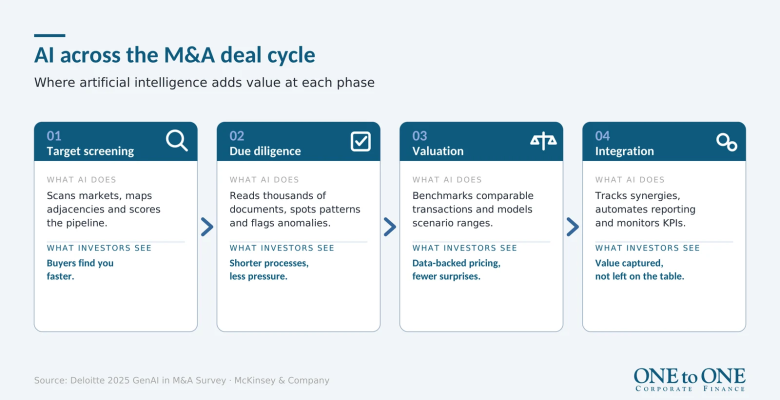
AI is used across every stage of an M&A transaction, from target screening and due diligence to valuation and integration. Investors use it to screen companies, analyse large volumes of documents and benchmark valuations. According to a Deloitte survey, 86% of senior corporate and private equity investors in the US have adopted generative AI in their M&A workflows, mostly in the early phases of a deal.
Can AI replace human judgment in M&A?
No. AI is a tool, not a decision-maker. It cannot understand a founder’s vision, build trust between buyer and seller, or find the compromise that saves a deal at the last minute. Valuation is not only a calculation — it is a negotiation shaped by people, relationships and judgment. AI handles the data so that advisors and entrepreneurs can focus on what truly matters.
How much faster are M&A deals with AI?
According to a McKinsey survey, deal cycles are on average 30–50% faster thanks to AI tools. This means shorter processes and less time spent under the pressure of due diligence for business owners. AI reads thousands of documents in hours, spots patterns and anomalies in financial data, and highlights risks that might otherwise be missed.
What should companies do to prepare for AI-driven due diligence?
Companies should ensure they have clean financials, structured data and a clear equity story. In a world where data is read by machines first, preparation matters more than ever. Well-prepared companies stand out faster, while inconsistencies and gaps are also detected more quickly by AI-powered analysis.
Is AI a threat to business owners in M&A?
No, AI is an ally for well-prepared companies. The future of M&A is not humans versus machines, it is technology handling the data so that advisors, investors and entrepreneurs can focus on understanding the business, building trust and making the right decisions. The question is not whether to fear AI, but how to make it work in your favour.

Author | Arnela Hodzic
Member of ONEtoONE Network
Arnela Hodzic is part of ONEtoONE Corporate Finance’s Italy network.
She is a former CFO with hands-on experience in financial strategy, M&A, FP&A, tax structuring and investor relations, and holds MBAs from LUISS Business School and Shanghai University of Finance and Economics.
Having previously led a company’s shift from a project-based model to recurring revenue and positioned the business for private equity investment, she helps founders, CEOs and investors with scaling, capital raising and M&A transactions, bridging corporate finance with technology, AI and cybersecurity.
About ONEtoONE Corporate Finance
ONEtoONE Corporate Finance is an M&A Advisory Network specialising in mergers and acquisitions for mid-market companies. With a presence in more than 50 countries, we support business owners and executives through the most important corporate decisions of their careers.