

Most entrepreneurs start thinking about investors when they think they are ready to sell or raise capital. By then, much of the outcome is already decided. Valuation, the quality of the investors at the table and the founder’s negotiating power all depend on work that should have started long before.
Investor readiness isn’t a phase of the deal. It’s a transformation of the business.
What investors are really buying
An investor isn’t paying for what a company has achieved, but for what it will generate in the future. The question behind every evaluation is simple: how confident can I be in tomorrow’s cashflows? Strong past results help, but if the future isn’t credible and easy to understand, the valuation suffers, or the deal never happens.
Being investor-ready means making that future credible.
The levers of value
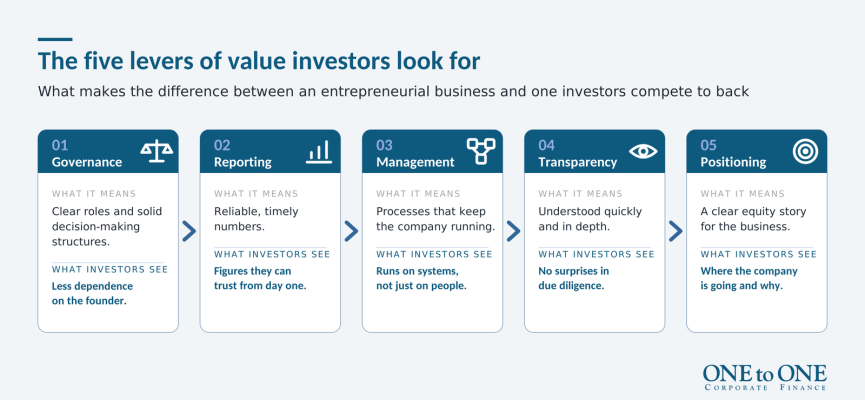
Different areas make the difference between an entrepreneurial business and one investors compete to back:
- Governance: clear roles, solid decision-making structures and less dependence on the founder.
- Financial reporting: reliable, timely numbers an investor can trust from day one.
- Management processes: a company that runs on systems, not just on people.
- Operational transparency: a business that can be understood quickly and in depth, with no surprises in due diligence.
- Strategic positioning: a clear equity story that explains where the company is going and why.
From assessment to full value
Getting there is a structured journey. It starts with understanding the business and the founder’s ambitions, followed by an honest assessment of where the company stands today: its strengths, its gaps and its hidden value. From there, a tailored roadmap is designed and put into action alongside management, step by step, until the business reaches its full value and is ready for the right opportunity.
What readiness gives you
A company that is truly investor-ready commands a higher valuation, attracts better investors and gives its founder more options, whether that means selling 100%, bringing in a minority partner, or continuing to lead the company after the transaction.
Most of all, it means negotiating from a position of strength.
Why the best time to prepare is now
For any entrepreneur thinking about the future of their company, the best time to start preparing is not when the deal is on the table. It’s now.
Frequently asked questions about investor readiness
What is investor readiness?
Investor readiness is the transformation of a business so that investors can trust its future, rather than a phase of the deal itself.
It rests on five levers of value: governance, financial reporting, management processes, operational transparency and strategic positioning. Because valuation and negotiating power depend on this work, it should start long before a sale or capital raise.
When should a company start preparing for investors?
The best time to start preparing for investors is now, not when the deal is on the table.
By the time most entrepreneurs think they are ready to sell or raise capital, much of the outcome is already decided. Valuation, the quality of the investors at the table and the founder’s negotiating power all depend on work that starts years before the transaction.
What do investors look for when valuing a company?
Investors pay for what a company will generate in the future, not for what it has already achieved.
The question behind every evaluation is how confident they can be in tomorrow’s cash flows. Strong past results help, but if the future isn’t credible and easy to understand, the valuation suffers or the deal never happens.
How do you make a company investor-ready?
A company becomes investor-ready through a structured journey that runs from an honest assessment of the business to a tailored roadmap executed alongside management.
The process starts with understanding the business and the founder’s ambitions, then assesses where the company stands today: its strengths, its gaps and its hidden value. The roadmap is then put into action step by step until the business reaches its full value and is ready for the right opportunity.
What are the benefits of being investor-ready?
An investor-ready company commands a higher valuation, attracts better investors and gives its founder more options.
Those options include selling 100%, bringing in a minority partner or continuing to lead the company after the transaction. Most of all, being investor-ready means negotiating from a position of strength.

Author | Arnela Hodzic
Member of ONEtoONE Network
Arnela Hodzic is part of ONEtoONE Corporate Finance’s Italy network.
She is a former CFO with hands-on experience in financial strategy, M&A, FP&A, tax structuring and investor relations, and holds MBAs from LUISS Business School and Shanghai University of Finance and Economics.
Having previously led a company’s shift from a project-based model to recurring revenue and positioned the business for private equity investment, she helps founders, CEOs and investors with scaling, capital raising and M&A transactions, bridging corporate finance with technology, AI and cybersecurity.
About ONEtoONE Corporate Finance
ONEtoONE Corporate Finance is an M&A Advisory Network specialising in mergers and acquisitions for mid-market companies. With a presence in more than 50 countries, we support business owners and executives through the most important corporate decisions of their careers.