

A “dead” M&A deal is a transaction that stalled and was quietly abandoned before closing. It almost never happens because the company lacks value. There are several key factors: the wrong buyer, the wrong timing, but above all, an owner who tried to negotiate the deal without the right advice. With the right M&A advisor, most buried deals could have closed successfully.
Most owners assume a failed deal is a verdict on their company. It rarely is. Many sale processes never reach signing. Most deals that do, also fail to meet the expectations set for them, usually because the process was managed without the right knowledge and advice, not because of the quality of the business.
And many transactions could have closed.
A buried transaction? A sale that stalled and was set aside. The value built is still there.
Is the deal really dead? That may not be true. Sometimes something that looks dead is just waiting for someone with the experience and knowledge in buying and selling companies to bring its true value to light and locate the potential buyers.
Why do M&A deals die before closing?
Most deals don’t die from a fatal flaw in the business, but from four avoidable causes:
- The wrong buyer.
- The wrong timing.
- The wrong story.
- Negotiating alone, without the support of an advisor specialised in buying and selling companies.
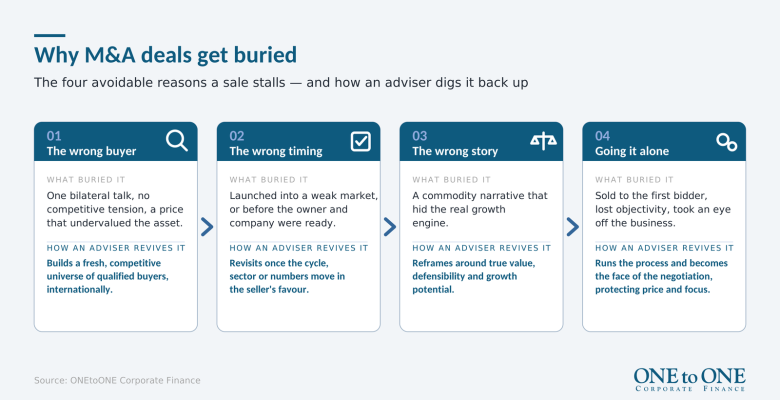
Each of them is made worse by time, which drains the momentum from any process.
A sale is a long, fragile sequence, and it can break at any point. The problem lies far more often in the conversation around it than in the company itself.
Through a lack of knowledge and experience, the business was shown to the wrong buyers, launched into the market at the wrong time, presented in a way that hid its strengths, or run single-handedly by an owner selling for the first time.
With the right advice, those mistakes would have been avoided, because none of these factors is terminal in itself. Each one is a reason to reopen the deal.
The four reasons a deal gets buried and how an advisor revives each
What buried the deal | What it looked like | How an advisor revives it |
The wrong buyer | One interested party, no competition, a price that undervalued the business | Builds a fresh, competitive universe of qualified strategic and financial buyers, internationally |
The wrong timing | Launched into a weak market, or before the owner and company were ready | Returns once the cycle, the sector or the numbers have moved in the seller’s favour |
The wrong story | A commodity narrative that hid the real growth engine | Reframes the business around its true value, defensibility and growth potential |
Negotiating without an advisor | Sold to the first bidder, lost objectivity, took an eye off the business | Runs the process, becomes the face of the negotiation, and protects both price and performance |
These four reasons rarely occur by themselves.
A weak story attracts the wrong buyers, which puts the owner at a disadvantage in negotiations and often leads to a lower sale price. As the process drags on, both sides can lose interest and the momentum fades.
A specialist advisor breaks this cycle by bringing the right buyers to the table, strengthening the owner’s negotiating position and keeping the process on track.
The wrong buyer
The best buyer is rarely the most obvious one, and there is usually more than one potential buyer. One of the biggest mistakes an owner can make is accepting the first offer that comes along.
When only one buyer is interested, the seller has little negotiating power. One solution can be to start again and identify buyers who would benefit from what the business offers, whether that is a new capability, a new market or a new customer base, alongside investors with a clear strategy. Competition between buyers improves both the price and the terms.
An advisor who is an expert in buying and selling companies is able to identify these synergies and make the most of them.
The wrong timing
A business that struggled to achieve the right price in a given market can look very different a year later, when interest in the sector returns, interest rates change or the company delivers another strong year. Timing is not simply about waiting.
It is essential to understand the market and choose the right moment to return, with the business prepared for close scrutiny. Preparation is key to a successful sale, and a deal that failed in a difficult market can succeed when conditions improve, provided the groundwork is done before going back to market.
The wrong story
The same financial results can describe a struggling business with little room to grow or a strong company with clear opportunities to expand. Buyers are more willing to pay for the latter.
This means building a clear, evidence-based story that explains where growth will come from, why margins are sustainable and what makes the business difficult to copy. A stronger story does not exaggerate the company’s value: it helps buyers understand its potential and prevents it from being undervalued.
The mistakes that bury a sale in the mid-market
Most buried deals share the same handful of avoidable mistakes:
- Taking your eye off the business: a dip in performance mid-process hands the buyer a reason to chip the price. It is essential that the owner focuses on preserving the value of the business and delegates the sale to an advisor who is an expert in selling.
- Skipping preparation: most of the outcome is decided before the first buyer meeting, depending on how well the company, the numbers and the story were prepared. And you need deep knowledge, not only of the company and the sector, but of the sale process itself.
- Letting diligence surprise you: Fixable issues surface at the worst possible moment and spook buyers.
- Carrying the negotiation alone: Without an advisor there’s no competitive tension, no objectivity about your own company, and the owner absorbs every pressure point personally.
The right advisor makes the difference
A failed deal rarely fails for the reason owners think. Usually the business was solid and the price was fair, but the wrong buyer, poor timing, a weak story or going it alone stalled the process and eroded value. But a buried deal is not necessarily a dead deal.
An advisor can turn a one-on-one negotiation into a competitive process by finding the right buyers, strengthening the story, protecting the terms that determine how much the seller actually keeps, and choosing the right moment to return to market. That is what can transform a failed deal into a successful one.
Have a deal you had already given up for buried? Let’s dig it back up together. Get in touch at onetoonecf.com.
Frequently asked questions
Why do most M&A deals fail to close?
Most deals stall for avoidable, process-related reasons rather than flaws in the business itself. These include finding the wrong buyer, choosing the wrong time to sell, presenting a weak business story or negotiating without professional support. As the process drags on, both sides can lose interest, creating deal fatigue that quietly kills the sale.
Many transactions fail to meet their objectives and, in the mid-market, only a fraction of sale processes reach completion. Often, the difference lies in preparation, buyer selection and how the sale is managed, rather than in the quality of the business.
Can a failed or abandoned business sale be revived?
Yes. A failed sale can be a valuable starting point for a new attempt, as the reasons the previous process broke down are often clearer and can be addressed.
An advisor can identify what went wrong, approach a wider pool of suitable buyers, strengthen the business story and choose the right moment to return to market. With better preparation and a more focused strategy, the next attempt can put the seller in a stronger negotiating position and improve the chances of closing successfully.
Should I sell my business without an advisor or broker?
You can attempt a sale alone, but it is difficult to maximise value without the right experience and negotiating leverage. An advisor brings transaction expertise, identifies the right buyers and creates competition between them, which helps improve both the price and the terms of the deal.
Managing a sale alone also divides your attention between negotiations and running the business. An advisor can lead the process, protect your interests and help maintain business performance, which is essential to preserving value throughout the transaction.
How long after a failed sale should you try again?
There is no fixed waiting period. The right time depends on what has changed since the previous attempt, whether that is stronger financial performance, more favourable market conditions, renewed interest in the sector or better preparation.
Returning to market without addressing the original problems risks repeating the same outcome. Use the time to strengthen the business, refine its positioning and resolve any issues that may concern buyers before launching another sale process.
What’s the difference between the “wrong buyer” and the “wrong timing”?
The wrong buyer means the business was presented to too few potential buyers, or to buyers who could not fully appreciate its strategic value. The solution is to broaden the search to include strategic acquirers and financial investors who may see opportunities others have missed. Greater competition can lift valuations and strengthen deal terms.
The wrong timing means the business went to market when buyer appetite was low, valuations were under pressure or the company was not ready for scrutiny. In this case, the priority is to improve preparation and return to market when conditions are more favourable, giving the business a better chance of attracting strong offers.
About ONEtoONE Corporate Finance
ONEtoONE Corporate Finance is an M&A advisory network specialising in mergers and acquisitions for mid-market companies. With a presence in more than 50 countries, we support business owners and executives through the most important corporate decisions of their careers.