

Poland is the fastest-growing large economy in the European Union and by far the biggest market in its region. That growth reaches the deal market through three forces at once. First, regional and international investors are using Poland as a platform for growth in Central and Eastern Europe. Second, Polish companies are buying abroad with growing confidence. Third, the generation that built businesses during the transition of the 1990s is reaching succession, adding to the supply of mature companies.
Why is Poland on the radar of M&A investors?
A quarter-century of catching up
Poland is the EU’s sixth-largest economy, with GDP of €922.9 billion in 2025, and it is still growing faster than almost any other member state. It grew 3.6% in 2025, against 0.3% in Germany and 0.9% in France, and the European Commission expects 3.5% in 2026, second only to Malta.
What matters more than size is how far Poland has come. In 2000, GDP per capita in purchasing power terms was about half that of Portugal or Greece and under 40% of Germany’s. By 2025 Poland had overtaken both Portugal and Greece, drawn almost level with Spain and reached three-quarters of the German level.
How does Poland compare with other EU economies?
| Country | GDP per capita, PPP 2000 (int. $) | GDP per capita, PPP 2025 (int. $) | Poland as % of country, 2000 | Poland as % of country, 2025 |
|---|---|---|---|---|
| Poland | 10,673 | 54,498 | – | – |
| Hungary | 11,855 | 49,147 | 90% | 111% |
| Greece | 19,519 | 43,801 | 55% | 124% |
| Portugal | 18,879 | 51,257 | 57% | 106% |
| Spain | 21,578 | 56,888 | 49% | 96% |
| Italy | 27,146 | 63,126 | 39% | 86% |
| Germany | 27,468 | 73,553 | 39% | 74% |
Eurostat tells the same story: Poland’s GDP per capita in purchasing power standards rose from 44% of the EU average in 1995 to 81% in 2025, its highest level on record. Convergence on this scale is what puts Poland on the radar of regional and international investors, and it sets three forces in motion that now shape the country’s M&A market.
What are the three forces reshaping M&A in Poland?
The three forces are foreign capital using Poland as a regional platform, Polish companies expanding abroad, and the succession wave among the founders of the 1990s.
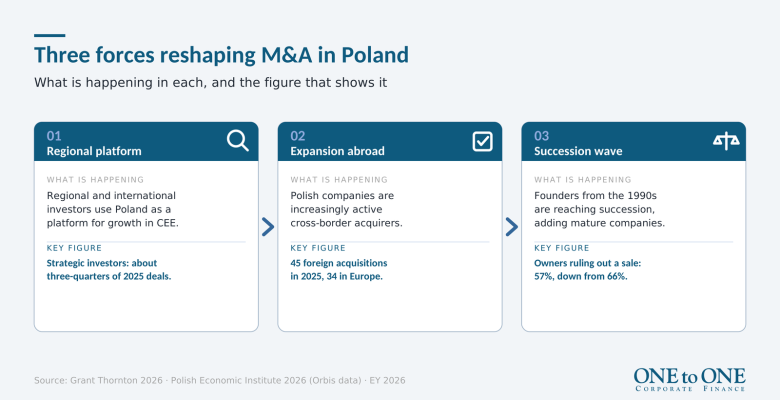
Force 1: Poland as a regional platform for foreign capital
Regional and international investors increasingly treat Poland as a strategic platform for growth in Central and Eastern Europe. Their motives differ:
- Regional private equity funds look for platforms they can scale.
- International strategic groups use Poland to consolidate fragmented sectors and build regional reach.
- Investors from smaller markets such as Czechia or Lithuania, for whom Poland is simply the natural next stage of expansion.
Which investors are building platforms in Poland?
Lithuania’s Invalda INVL calls Poland the largest market in the region, could invest up to around €160 million there and expects its portfolio companies from other countries to acquire in Poland too. Czech Jet Investment made Plastiwell the first Polish deal of its Jet 3 fund and is raising a Jet 4 fund of up to €350 million for 8–12 Central European acquisitions. Czech Pale Fire Capital has announced plans to invest at least €100 million in Poland, including in companies facing succession, although these are declared intentions rather than completed deals.
Private equity also generates deal flow through exits. Jet Investment, for example, sold Rockfin after nearly tripling its revenue to €235 million in under four years.
Which strategic deals show the trend?
International strategic investors are active too. The table shows four representative transactions.
| Buyer | Origin | Target | Sector and value | Status |
|---|---|---|---|---|
| Erste Group | Austria | Santander Bank Polska (49%) | Banking / asset management, €7.0 bn total (49% of the bank and 50% of its asset management company) | Completed January 2026 |
| Alimentation Couche-Tard | Canada | Żabka | Convenience retail | Announced in 2026 |
| Deutsche Telekom | Germany | Fiberhost, Inea | Telecoms | Announced in 2026 |
| K+S | Germany | Qemetica salt business (Janikowo, Poland and Stassfurt, Germany) | Chemicals, €350 m + up to €30 m earn-out | Announced in 2026 |
How active is Poland's M&A market?
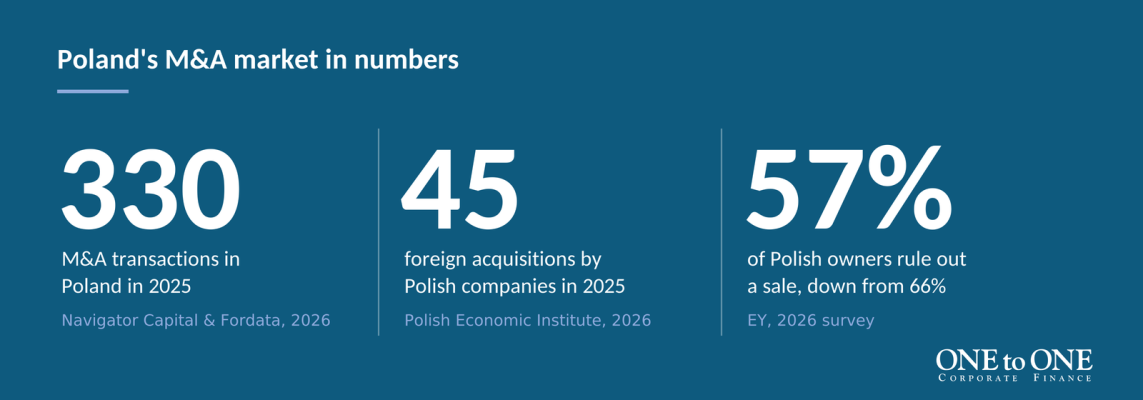
Strategic investors accounted for around three-quarters of M&A transactions in Poland in 2025, according to Grant Thornton, while fund activity also rose visibly. Poland recorded 330 M&A transactions in 2025, slightly fewer than in 2024 but still above 300 for the fourth year running, and it remains the most active market in the region by number of deals.
Force 2: Polish companies expanding abroad
Polish companies have accumulated the financial resources, management capabilities and international ambitions to become increasingly active cross-border acquirers. According to the Polish Economic Institute (PIE), based on Orbis data, Polish firms completed 45 foreign acquisitions in 2025. Thirty-four of them were in Europe, including nine in Germany and three each in Czechia and Romania; the US followed with six.
Which deals stand out?
Two transactions show the scale. Benefit Systems completed the acquisition of the Turkish fitness chain Mars Spor Kulübü in 2025 for about PLN 1.6 billion (about €380 million). Grupa Kęty’s acquisition of the Italian aluminium extrusion group Metra, announced in 2026, has an enterprise value of €645 million.
How does the state support expansion abroad?
The state actively supports this. Under the Team Poland initiative, six state institutions combine equity, debt, guarantees and promotion, and the Polish Development Fund’s Foreign Expansion Fund co-finances acquisitions abroad. There is plenty of headroom: Poland’s stock of outward foreign direct investment equals only about 4% of GDP, against an EU average of about 77%. That ratio describes accumulated investment rather than annual deal flow, but it shows how early Polish companies still are in building international portfolios.
Force 3: the succession wave
Why is succession becoming an M&A driver?
Across Central and Eastern Europe, a very large cohort of entrepreneurs built their businesses during the transition of the 1990s. Many of them are now in their 60s and 70s, and succession has become a real ownership question rather than a distant one. The scale of that first generation is visible in Poland: according to the Family Business Foundation and EY, as reported by Forbes Polska, approximately 13,800 businesses established in 1989 were still operating in 2024, representing 53% of the companies founded that year.
How are owners' attitudes changing?
Owners’ attitudes are shifting. In EY’s 2026 survey, the share of Polish business owners who did not consider selling their company fell from 66% a year earlier to 57%. Family transfer remains a common preferred route, but formal succession plans and openness to outside capital are both rising.
In our experience, succession is increasingly becoming one of the key strategic challenges facing Polish business owners. While some can rely on the next generation, others are increasingly open to bringing in an external investor or selling to a strategic buyer.
What does succession mean for the supply of companies?
For the market, this is a structural trend rather than a one-off wave: a growing supply of mature, profitable companies, often niche leaders in manufacturing, distribution or business services. These are exactly the targets sought both by the investors behind Force 1 and by Polish groups consolidating at home before expanding abroad.
Outlook: how the three forces work together
The three forces do not act separately. Succession increases the supply of businesses for sale, regional and international investors and Polish groups compete for them, and economic convergence supports valuations. The energy transition and high public spending on infrastructure and defence act as additional deal catalysts. Candidates for a fourth and fifth force, the state as an active dealmaker and nearshoring, are already on the horizon.
What do these trends mean for owners and investors?
- For an outside investor: Poland is a chance to build a platform in the region’s largest market.
- For a Polish company: Poland is a base to consolidate at home and then buy abroad.
- For business owners: owners who start thinking about a sale or succession early usually have more options and more time to prepare the business for the right investor.
Frequently asked questions about M&A in Poland
How active is the M&A market in Poland?
Poland recorded 330 M&A transactions in 2025 and remains the most active market in Central and Eastern Europe by number of deals.
The total was slightly lower than in 2024 but stayed above 300 for the fourth year running. Strategic investors accounted for around three-quarters of transactions, according to Grant Thornton, while fund activity also rose visibly.
Why do foreign investors acquire companies in Poland?
Foreign investors use Poland as a platform for growth in Central and Eastern Europe because it is the biggest market in the region and the fastest-growing large economy in the European Union.
Regional private equity funds look for platforms they can scale, international strategic groups use Poland to consolidate fragmented sectors and build regional reach, and investors from smaller markets such as Czechia or Lithuania see it as the natural next stage of expansion. Poland’s GDP reached €922.9 billion in 2025 and grew 3.6%.
Are Polish companies buying businesses abroad?
Yes. Polish firms completed 45 foreign acquisitions in 2025, 34 of them in Europe, according to the Polish Economic Institute, based on Orbis data.
Germany was the most frequent destination with nine deals, and the US followed with six. There is plenty of headroom: Poland’s stock of outward foreign direct investment equals only about 4% of GDP, against an EU average of about 77%.
Why is succession driving M&A in Poland?
Many entrepreneurs who built their businesses during the transition of the 1990s are now in their 60s and 70s, so succession has become a real ownership question rather than a distant one.
In EY’s 2026 survey, the share of Polish business owners who did not consider selling their company fell from 66% a year earlier to 57%. The result is a growing supply of mature, profitable companies, often niche leaders in manufacturing, distribution or business services.
When should a business owner start preparing for a sale or succession?
Early. Owners who start thinking about a sale or succession early usually have more options and more time to prepare the business for the right investor.
Some owners can rely on the next generation, while others are increasingly open to bringing in an external investor or selling to a strategic buyer. Starting early leaves time to choose between these routes.
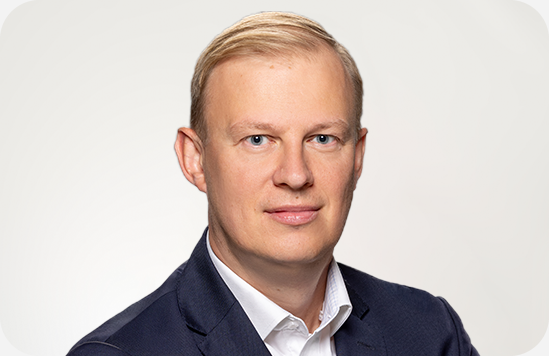
Author | Wojciech Baran ONEtoONE Corporate Finance M&A Advisor
Wojciech Baran is an M&A advisor at ONEtoONE Corporate Finance in Poland.
He is a CFA charterholder with nearly 20 years of experience in corporate finance and investment banking, including senior positions at Ernst & Young Corporate Finance, IPOPEMA Securities and ISD Group.
Having executed M&A and financing projects with a total value exceeding EUR 500 million, he specialises in domestic and cross-border M&A in the industrial, business services, and energy and sustainability sectors.
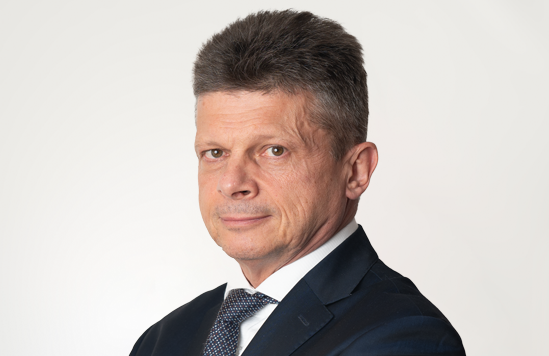
Author | Mariusz Kolwas ONEtoONE Corporate Finance M&A Advisor
Mariusz Kolwas is an M&A advisor at ONEtoONE Corporate Finance in Poland.
He is an experienced executive with a track record in financial management, operational leadership and strategic growth across financial services, automotive, IT and subscription-based services, and has been a member of ACCA since 2001.
Having led nine startups and scale-ups backed by private equity funds and taken part in eight acquisitions, he specialises in restructuring, process optimisation and securing financing.
About ONEtoONE Corporate Finance
ONEtoONE Corporate Finance is an M&A Advisory Network specialising in mergers and acquisitions for mid-market companies. With a presence in more than 50 countries, we support business owners and executives through the most important corporate decisions of their careers.