

When two companies from different countries decide to establish a joint venture or pursue an acquisition together, one of the first questions they address is ownership: who will own what percentage of the business? It is an important question, but it is rarely the most difficult one.
In my experience advising on Japanese-Saudi business partnerships, some of the most challenging discussions were not about how much each party would own, but about what that ownership would mean in practice. Who would control the business? Who would appoint management? Which decisions would require both parties’ approval? And how could each shareholder protect its interests without restricting the other?
I encountered these questions across different types of assignments, including establishing joint ventures, advising on acquisitions, restructuring existing partnerships and helping shareholders reconsider their ownership and control arrangements.
One recurring lesson was that agreeing on the ownership percentage is only part of the negotiation. The more difficult task is agreeing on how the business will actually be run.
In the first article of this series, I explored why strategic fit is only the beginning of a successful cross-border transaction. This second article looks at what comes next: how ownership, control and governance should be structured to support the business and protect the interests of its shareholders.
Does ownership necessarily mean control?
It is tempting to assume that the shareholder with the largest ownership stake will naturally have the greatest influence over the business. In practice, this is not always the case.
Majority ownership in Japanese-Saudi partnerships
I have seen this distinction become particularly important in negotiations between Japanese companies and Saudi partners. Japanese investors entering the Saudi market sometimes preferred majority ownership, reflecting their desire to maintain control over technology, operational standards, management and the direction of the investment. Their Saudi counterparts, meanwhile, wanted to ensure that their contribution, local market position and long-term interests were properly reflected in the governance of the business. Neither position was unreasonable. Each reflected a different perspective on the investment and the responsibilities involved.
Does a 50:50 ownership structure resolve control?
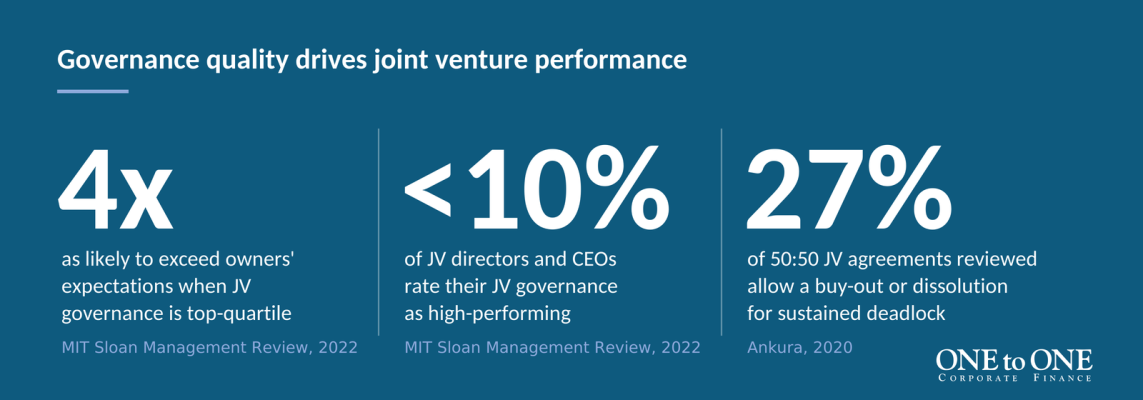
In some negotiations, the parties eventually considered or agreed on a 50:50 ownership structure. While this could provide a sense of balance, it did not automatically resolve the question of control. In fact, equal ownership could make decision-making more complicated if the parties had not agreed in advance on how important decisions would be taken.
Ownership and control: what is the difference?
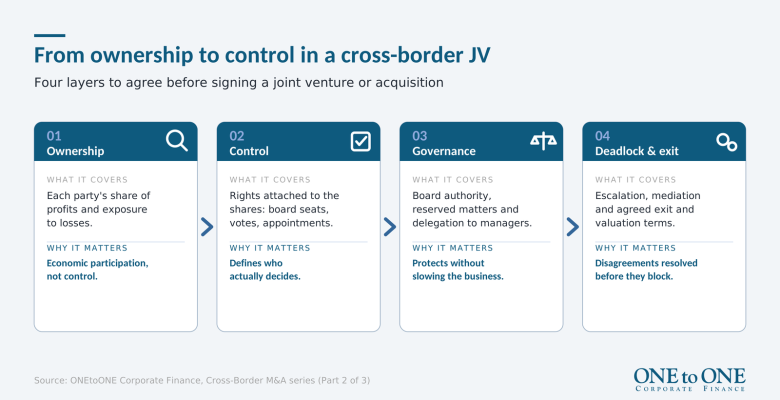
This is an important distinction for investors and business owners to understand. Ownership determines economic participation, including entitlement to profits and exposure to losses. Control, however, depends on the rights attached to those shares, the governance arrangements and the way decisions are made. A well-designed structure should reflect the contributions, responsibilities and legitimate interests of both parties, rather than relying on ownership percentages alone.
The real negotiation begins with governance
In cross-border transactions, governance is often where the commercial expectations of the parties become most visible. During my work with Japanese and Saudi businesses, I found that discussions about management authority, reporting requirements and approval procedures could be just as important as negotiations over valuation and ownership.
Different expectations of international and local partners
An international investor may be accustomed to centralised decision-making, strict reporting requirements and formal approval processes. A local partner may expect greater flexibility in managing day-to-day operations and responding to market developments. These differences do not necessarily create a problem. They become problematic when the governance structure does not clearly define how the business should be managed.
For example, the parties may agree on the composition of the board but leave insufficient clarity around its authority. They may agree that certain decisions require shareholder approval without defining precisely which decisions fall into that category.
Which decisions should joint venture governance cover?
Important matters to address include:
- Approval of annual budgets and business plans.
- Appointment or removal of senior management.
- Major capital expenditure and additional funding.
- Borrowing, guarantees and material contractual commitments.
- Changes to the business strategy or scope of operations.
- Use, protection and licensing of intellectual property.
- Related-party transactions and distributions.
These are not simply legal drafting matters. They determine how quickly the company can respond to opportunities, manage risks and execute its business plan. The objective should be to establish a governance framework that provides appropriate protection without making the business unnecessarily difficult to operate.
Protecting the investment without restricting the business
One of the most delicate aspects of negotiating a cross-border transaction is balancing the need to protect an investment with the need to give the business sufficient room to grow. In industrial and technology-related partnerships, this can be particularly sensitive.
Technology, intellectual property and local contribution
An international company contributing technology, intellectual property or specialised know-how may be concerned about how those assets will be used. It may want approval rights over licensing arrangements, technical modifications or the transfer of proprietary information. A Saudi partner, on the other hand, may have invested capital, developed customer relationships, provided infrastructure and taken responsibility for establishing the business in the local market. It will reasonably expect meaningful involvement in decisions that affect its investment and long-term position.
I encountered these considerations in several partnerships involving manufacturing, engineering, industrial automation and other technology-related activities. The discussions were not simply about who would own the company. They were also about the extent of technology transfer, the development of local capabilities, the responsibilities of each shareholder and the future direction of the business. Both parties have legitimate interests. The challenge is to translate those interests into practical arrangements.
How to protect both parties in practice
For example, certain decisions may require joint approval, while day-to-day operational matters can be delegated to management within an agreed budget and business plan. Intellectual property protections can also be clearly defined without preventing the local business from carrying out its agreed activities. The key is to protect what is essential to each party without creating unnecessary restrictions on the business.
When should you compromise, and when should you stand firm?
One of the most important skills in cross-border M&A is recognising the difference between issues where compromise is possible and those that are fundamental to the investment rationale. An investor may be flexible on the timing of certain commitments, the composition of management or the introduction of new reporting procedures. These matters can often be addressed through phased arrangements, clear responsibilities or agreed performance targets.
However, compromising on the protection of critical intellectual property, the ability to monitor invested capital or essential decision-making rights may undermine the very reasons for entering the transaction.
The local partner's perspective
The same principle applies to local partners. They may be prepared to accept certain international reporting standards or technical controls, but should not overlook their legitimate role in decisions affecting the business they are helping to establish and develop.
In my experience, successful negotiations are not necessarily those in which one party secures every point it initially sought. They are those in which both parties understand what is essential, where flexibility is possible and what compromises will allow the business to move forward. The objective is not to win every negotiating point, nor to reach an agreement at any cost. It is to protect the essential interests of both parties while creating a structure that allows the business to succeed.
What happens when shareholders cannot agree?
This is a question that should be addressed before the relationship encounters difficulties. In a joint venture, disagreements are not necessarily a sign that the partnership is failing. Differences over investment priorities, expansion plans or the allocation of resources are normal, particularly when shareholders have different strategic objectives. The problem arises when the governance arrangements do not provide a workable way to resolve those disagreements.
What is a deadlock in a joint venture?
A deadlock can occur when shareholders are unable to reach agreement on a decision that requires their joint approval. If the issue concerns an important budget, a major investment or the appointment of key management, the consequences can be significant.
Resolving disagreements and planning an exit
The parties should therefore agree in advance on how disagreements will be escalated and resolved. This may involve discussions between senior executives, escalation to the shareholders, mediation or other agreed mechanisms. They should also consider the circumstances in which one party may wish to sell its interest, whether the other shareholder has a right to acquire it, and how an exit would be valued and implemented.
Having been involved not only in establishing partnerships but also in subsequent restructuring and changes in ownership, I have seen why these arrangements matter. A structure that works at the beginning of a relationship may become less suitable as the business develops, market conditions change or the shareholders’ priorities evolve. A clear exit framework is therefore not an expectation that the partnership will fail. It is part of responsible planning.
Governance should evolve with the business
A governance structure agreed at the beginning of a transaction may not remain appropriate indefinitely. A newly established joint venture may initially require close shareholder involvement, particularly when it is setting up operations, recruiting management and developing its customer base. As the business matures, however, excessive shareholder intervention can slow decision-making and limit management’s ability to respond to the market.
How joint venture governance can evolve
The parties should consider how responsibilities and decision-making authority may evolve as the business develops. This could include delegating greater authority to management, reviewing board composition as the business expands, or revisiting funding and approval arrangements when the company enters a new phase of growth.
The important point is to avoid treating governance as something that is agreed once and never reconsidered. It should support the company’s development while continuing to protect the shareholders’ interests.
Ownership is the starting point, not the answer
Cross-border acquisitions and joint ventures can bring together complementary capabilities, capital, technology and market access. But the ownership structure alone does not determine whether the partnership will work.
The parties must agree not only on how much of the business each will own, but also on how decisions will be made, how their respective interests will be protected and how disagreements will be handled.
These discussions may take time, and they can sometimes be uncomfortable. But addressing them early is far better than discovering fundamental differences after the business has been established and substantial resources have been committed.
Ultimately, a successful partnership is not one in which one shareholder gets its way on every issue. It is one in which both parties understand their rights and responsibilities, trust the governance arrangements and remain committed to building a business that creates value for everyone involved.
In the third and final article of this series, I will turn to what happens after the transaction closes: why integration, relationships and execution often determine whether the value anticipated at signing is actually achieved.
Frequently asked questions
What is the difference between ownership and control in a joint venture?
Ownership determines economic participation, including entitlement to profits and exposure to losses, while control depends on the rights attached to the shares, the governance arrangements and the way decisions are made.
A well-designed structure reflects the contributions, responsibilities and legitimate interests of both parties, rather than relying on ownership percentages alone.
Does a 50:50 joint venture mean equal control?
Not automatically. Equal ownership can provide a sense of balance, but it does not resolve the question of control.
If the parties have not agreed in advance on how important decisions will be taken, a 50:50 structure can make decision-making more complicated and increase the risk of deadlock.
Which decisions should require approval from both joint venture shareholders?
Typically the decisions that matter most to each party’s investment: annual budgets and business plans, senior management appointments, major capital expenditure and funding, borrowing and guarantees, changes in strategy, intellectual property, and related-party transactions and distributions.
Day-to-day operational matters can be delegated to management within an agreed budget and business plan, so the investment is protected without making the business difficult to operate.
How do you resolve a deadlock in a joint venture?
By agreeing in advance how disagreements will be escalated and resolved, for example through discussions between senior executives, escalation to the shareholders or mediation.
The parties should also agree when one of them may sell its interest, whether the other has a right to acquire it, and how an exit would be valued and implemented.
Should joint venture governance change as the business grows?
Yes. A governance structure agreed at the beginning of a transaction may not remain appropriate as the business matures.
This can mean delegating greater authority to management, reviewing board composition or revisiting funding and approval arrangements when the company enters a new phase of growth.

Author | Ghassan Khalil
ONEtoONE Corporate Finance M&A Advisor
Ghassan Khalil is an M&A advisor at ONEtoONE Corporate Finance in Saudi Arabia.
He is an investment banker with more than 25 years of experience in corporate finance, M&A, capital markets and private equity, including joint ventures, restructuring, ECM, DCM and IPO execution.
Having advised top-tier clients across the MENA region, including Japanese companies seeking to enter or expand in Saudi Arabia, he specialises in cross-border M&A, joint ventures and capital markets transactions across the MENA region.
About ONEtoONE Corporate Finance
ONEtoONE Corporate Finance is an M&A Advisory Network specialising in mergers and acquisitions for mid-market companies. With a presence in more than 50 countries, we support business owners and executives through the most important corporate decisions of their careers.