

Business valuation methods are financial techniques that estimate a company’s value range from its ability to generate cash, the prices paid for comparable companies or its net assets.
Thinking about selling your business? Speak to an M&A adviser and find out what it is worth.
Knowing what your company is worth is the first step in any sale, but it also helps you understand your position in the market and identify which levers create value. In ONEtoONE’s experience of mid-market transactions, an owner’s idea of what the company is worth and the value a buyer places on it are often far apart. For the founder, the company is their life’s work; the buyer assesses it without emotion and asks how they will recover what they pay.
What determines how much a company is worth?
A company’s value depends on how much profit it can generate in the future, adjusted for the risk of not achieving it, and on factors such as the type of buyer, market conditions, the seller’s circumstances and the quality of the information.
- Profitability and risk: buyers value the ability to generate cash and how stable it is; customer loyalty adds a great deal of value, even if it is hard to measure.
- Type of buyer: a financial investor seeks a return over a set period; a strategic buyer may pay for synergies, market share or a new business line.
- Personal circumstances: a forced sale means accepting weaker offers; the more time there is to sell, the better the price tends to be.
- Market conditions: when deal multiples in the sector are high, your company is worth more, even if it is not listed.
- Quality of information: without reliable historical financial data, every method loses accuracy.
What are the main business valuation methods?
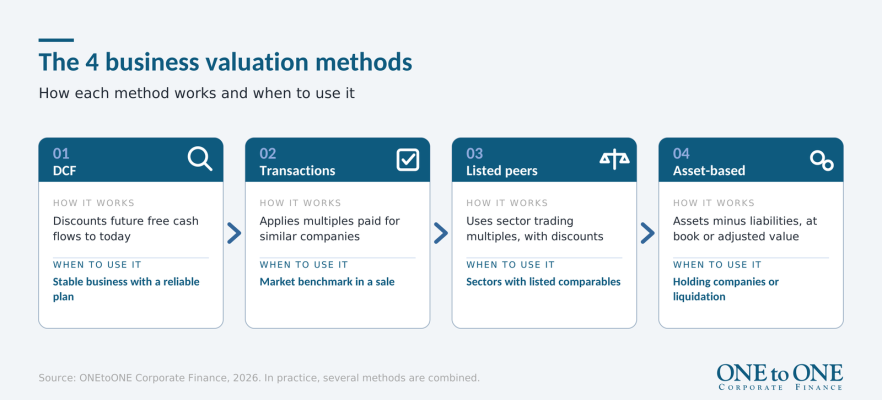
There are four main business valuation methods: discounted cash flow (DCF), comparable transaction multiples, trading multiples of listed companies and asset-based methods.
Summary table: the 4 business valuation methods
| Method | How it works | When to use it |
|---|---|---|
| Discounted cash flow (DCF) | Brings future free cash flows back to today at a rate that reflects risk | Stable business with a reliable business plan |
| Comparable transaction multiples | Applies to EBITDA the multiple paid in acquisitions of similar companies | As a market benchmark in a sale process |
| Trading multiples of listed companies | Applies sector stock market multiples, with size and liquidity discounts | Sectors with truly comparable listed companies |
| Asset-based methods | Assets minus liabilities, at book or adjusted value | Holding companies, asset-rich firms or liquidation |
How is each valuation method applied?
Each method answers a different question, which is why several are combined in practice and a value range is presented.
1. Discounted cash flow (DCF)
Free cash flows for the next five to ten years are projected, a terminal value is calculated, and everything is discounted to today at a rate that reflects risk. Its great advantage is that it captures future earnings capacity; its drawback is that it requires many assumptions.
2. Comparable transaction multiples
This method looks at the prices paid in previous deals for similar companies: similar businesses should sell at similar multiples. It is the most widely used because it is quick, but if applied poorly it can stray from reality. Avoid comparables whose sales or profits are less than half those of the target company. See our article on the multiples valuation method.
3. Trading multiples of listed companies
This works the same way but uses the multiples at which listed companies in the sector trade. The data are public, but discounts must be applied because listed companies are usually larger and more liquid than an SME.
4. Asset-based methods
These start from the balance sheet: assets minus liabilities. They are useful for holding companies or businesses in liquidation, but they do not capture earnings capacity and rarely reflect the value of a going concern.
Thinking about selling your business?
Speak to a M&A adviser to find out what your company is worth.
How do I value my company step by step?
To value a company, you gather and normalise its financial data, project a business plan, apply at least two methods and reconcile the results into a value range.
- Gather the information: accounts for the last three to five years and details of debt, cash and working capital.
- Normalise EBITDA: remove one-off items and adjust shareholder remuneration to market levels.
- Project the business plan: sales, margins and investment consistent with the track record.
- Apply DCF and multiples: and explain the differences between them.
- Move to equity value: deduct net financial debt (enterprise value vs equity value).
Illustrative example: a company with normalised EBITDA of €2 million, valued at 8 times, would have an enterprise value of €16 million. With €5 million of net financial debt, the equity value would be €11 million. The actual multiple depends on each company’s sector, size and risk.
Conclusion
No valuation method is perfect on its own. A good valuation combines several, relies on reliable data and sector knowledge, and gives the seller arguments to negotiate with rather than expectations. Discover our company valuation service and download our free business valuation methods eBook.
Frequently asked questions
What is the best method to value a company?
No single method is best in every case: for a going concern, the usual approach is to combine discounted cash flow with comparable transaction multiples and present a value range.
Asset-based methods are only suitable for asset-holding companies or businesses in liquidation.
How many times EBITDA is a company worth?
There is no single multiple: it depends on the sector, size, growth, profitability, risk and type of buyer.
In ONEtoONE’s experience, creating competition between financial and strategic buyers is one of the levers that most raises the final multiple.
Why does a valuation give a range rather than an exact figure?
Because each method starts from different assumptions and value depends on who is buying and why.
The final price is set in the negotiation, depending on competition between buyers, synergies and payment terms.
What is normalised EBITDA?
It is operating profit before depreciation and amortisation, cleaned of one-off income and expenses, which reflects the company’s real and repeatable profitability.
It is the base to which multiples are applied; a common adjustment is bringing shareholder remuneration to market rates.
Is the company's value what the shareholder receives?
No. The shareholder receives the equity value, which is the enterprise value minus net financial debt.
We explain it in don’t confuse the company’s value with the value of shares.
About ONEtoONE Corporate Finance
ONEtoONE Corporate Finance is an M&A advisory network specialising in mergers and acquisitions for mid-market companies. With a presence in more than 50 countries, we support business owners and executives in the most important corporate decisions of their careers.